Issue 022
Topic: Everyday tech
You don't need a tutorial. You need permission to stop apologizing.
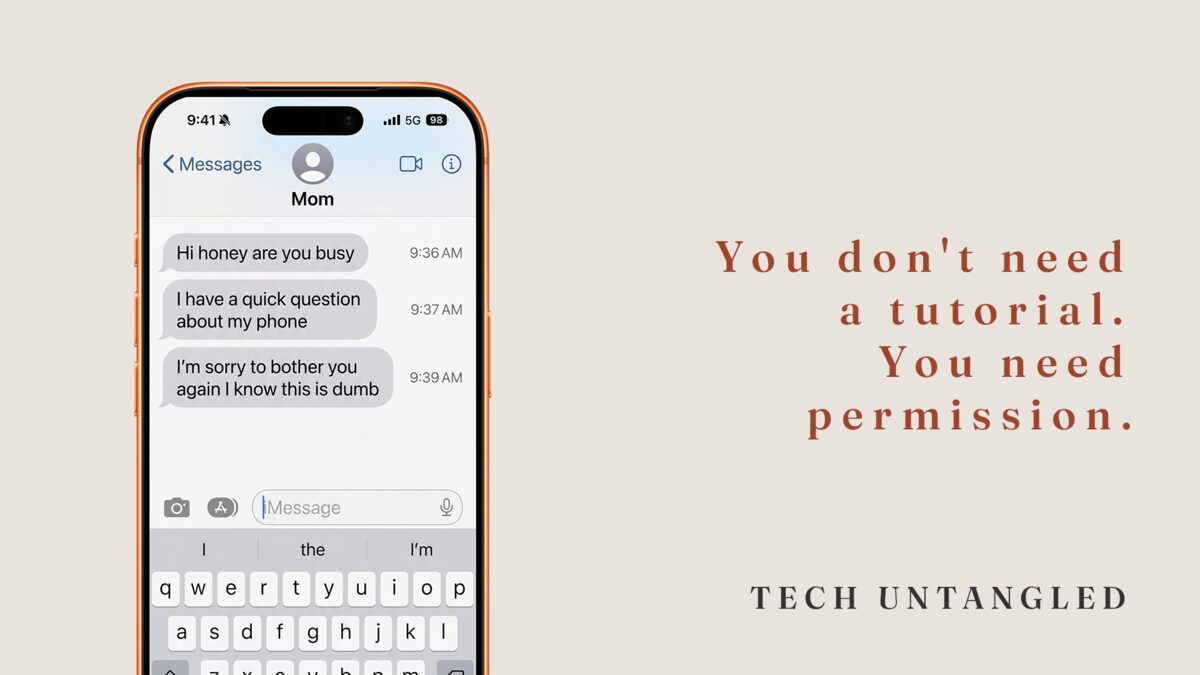
I was at the Dunkin' in Canton last week, two tables down from a woman who had to be in her seventies. She was on the phone with someone, voice slightly raised the way people do when they think the volume is the problem. Her phone was face-up on the table next to her coffee. She was trying to add a contact, or save one, or something. I wasn't trying to listen. The place isn't that big.
But before she asked her question, she said this: "I know this is so stupid, and I'm so sorry to bother you with it again."
She hadn't asked the question yet. She was apologizing for it preemptively. And then she asked it, and got an answer, and got off the phone, and her shoulders dropped about two inches like she'd just been let off a hook.
I watched her sit there for a minute with her phone, looking at it the way you look at a thing that just embarrassed you in public.
The apology before the question
Watch what happens when an adult over a certain age asks for help with their phone. There's almost always a sentence that comes before the actual question. "I know this is dumb." "I'm sorry to keep asking." "I should know how to do this by now." "You're going to laugh."
Then comes the question.
The question is fine. The question is reasonable. The question usually has a real answer that takes thirty seconds. But the apology has already done its work. It has told the person on the other end that this is going to be embarrassing. It has told the person asking that they're a burden for asking.
The apology was not always there. There was a first time someone said it. And then a second time, because the first time worked. Saying "I know this is dumb" before asking a tech question lowers the stakes if the answer makes you feel smaller, which it often has.
The apology was never about the phone. It was about every previous time the answer made someone feel smaller.
Confusion is not a character flaw
Confusion is what happens when something is never explained. That's it. That's all it is. If you've never been taught how a settings menu is organized, then a settings menu is going to feel chaotic. If you've never been shown what an app is doing in the background, then your phone's behavior is going to feel mysterious. The confusion is appropriate. It is the predictable response to a system nobody explained.
What's not appropriate is the shame that arrived next.
Tech companies have spent two decades putting products into the hands of adults without ever teaching them how the products work. They built tutorials for children and assumed everyone else would figure it out. When adults didn't figure it out, the industry didn't reconsider. It just sold the next product.
The apology is the residue of that. It's what happens when an industry's silence gets internalized as a personal flaw.
What the apology actually costs
The apology is a defense mechanism. It's a way of getting ahead of the embarrassment. If you call yourself stupid first, then nobody else has to. If you preempt the judgment, then maybe the judgment never comes.
But it costs something. Every time you apologize before asking a question, you reinforce the idea that asking the question was a problem. You teach yourself, again, that needing help with technology is something to be sorry about. And then you ask less. You wait longer to ask. You quietly stop using features you paid for, because the act of asking has become more expensive than the inconvenience of going without.
I've watched people stop using FaceTime because they got tired of feeling bad every time they tried to start a call. The phone wasn't broken. The teaching was broken. And the cost wasn't a missed feature. It was a year of not seeing their grandkids' faces clearly.
What's not resolved is whether tech companies will ever take responsibility for the population they spent two decades dismissing. Probably they won't. They haven't had to before. So the work of teaching, for now, falls to the rest of us. That's a frustrating fact, but it's where we are.
What to do instead
If you're the one asking: stop apologizing first. The apology does not make the question easier to answer. It makes the next question harder to ask. Try the question without the apology. Just the question. "How do I save this contact?" "How do I delete this email?" The answer will come out the same. You will feel different.
If you're the one being asked: notice the apology when it happens. Don't laugh, even kindly. Don't say "it's fine." Both reinforce that an apology was needed in the first place. Just answer the question. Then, if you can manage it, say one true thing back: "Nobody taught you that. There's no reason you'd know it."
That sentence is the lever. It is small, and it does enormous work. It puts the failure where it belongs, which is on the system that didn't explain itself, not on the person trying to use it.
If you have a parent, an aunt, a neighbor, a former colleague who has stopped asking, they didn't lose interest. They got tired of apologizing. Tell them they don't have to anymore.
One simple win
The next time you ask anyone for help with technology, your kid, your spouse, your friend, the IT person at work, try asking the question without the apology. No "I know this is dumb." No "I'm sorry to bother you." Just the question.
Watch what happens. The answer will come out the same. You will feel different. And the next question will be easier to ask than the last one.